 By peter_lzh
 What if you could have Warren Buffett, Charlie Munger, and Peter Lynch analyze the same stock — all at the same time?
Honestly? That was pure fantasy not long ago. But a GitHub project just made it real.
It’s called ai-hedge-fund. In less than a year, it’s racked up nearly 60,000 stars and 10,000+ forks, even briefly topping the GitHub Trending charts ahead of OpenManus. And what it does is pretty wild: it encodes the thinking patterns of 13 legendary investors into AI agents and has them analyze stocks — simultaneously — and spit out investment recommendations.
Best part? It’s fully open source.
Meet the 19 AI Agents in This Open-Source Trading System
Dig into the repo and you’ll find a system built of 19 AI agents organized into three categories:
Category 1: Legendary Investor Agents (13)
Each of these 13 agents is modeled after a real investing legend’s style:
- Warren Buffett — The Oracle of Omaha, hunting for wide-moat businesses at fair prices
- Charlie Munger — Only buys great businesses; obsesses over management quality and predictability
- Benjamin Graham — The father of value investing, strict about margin of safety
- Peter Lynch — Spots ten-baggers in everyday life
- Cathie Wood — All in on disruptive innovation and tech-driven change
- Michael Burry — The “Big Short” original, a deep-value hunter with a contrarian streak
- Nassim Taleb — Black Swan risk analyst, focused on tail risks and antifragility
- Paul Tudor Jones — Macro trading legend, always hunting for asymmetric opportunities
The lineup also includes Bill Ackman (activist investing), Phil Fisher (scuttlebutt research), Monish Pabrai (Dhandho investing), and more.
Category 2: Professional Analysis Agents (4)
- Valuation Agent — Calculates intrinsic value of stocks
- Sentiment Agent — Tracks bullish/bearish market sentiment
- Fundamentals Agent — Interprets financial data
- Technical Agent — Analyzes chart trends and patterns
Category 3: Risk & Decision Agents (2)
- Risk Officer — Measures exposure, sets position limits
- Portfolio Manager — Aggregates all signals and makes the final call
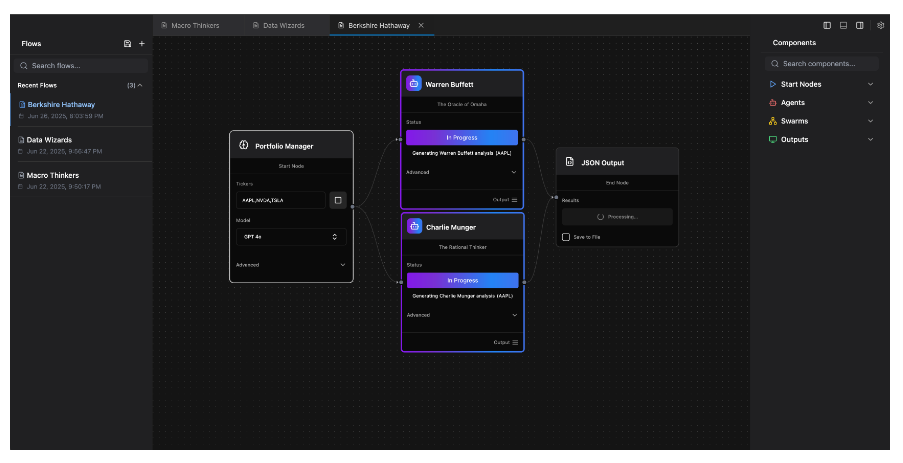
Here’s how it works: once launched, all 13 investor agents and 4 analysts go to work in parallel — each independently analyzing the data and generating conclusions and trade signals. The risk officer reviews everything for exposure, then the portfolio manager makes the final decision. A complete “Wall Street Dream Team,” running on your machine.
Putting It to the Test on A-Shares
One blogger swapped OpenAI for DeepSeek (cost: roughly ¥0.10 per analysis) and ran real tests on China’s A-share market:
Kweichow Moutai ($600519): Buffett’s agent flagged a strong brand moat but considered the valuation too rich — “Hold.” Munger’s agent worried about slowing growth and policy risk — also “Hold.” Lynch’s agent agreed it’s still a quality asset but better for conservative allocation. Verdict: Hold. 30 days later, Moutai was up 3.2%.
CATL ($300750): Buffett’s agent went straight to “Sell,” arguing the new energy sector was too competitive with an unstable moat. Munger and Lynch both said “Hold.” The final call was Hold — but 30 days later, CATL dropped 5.8%. Turns out Buffett’s agent was onto something.
Ping An Bank ($000001): Two out of three said “Buy.” After 30 days, it gained 1.5%.
Impressive? Well, don’t get too excited.
Should You Bet Real Money on It?
Probably not. At least, not yet.
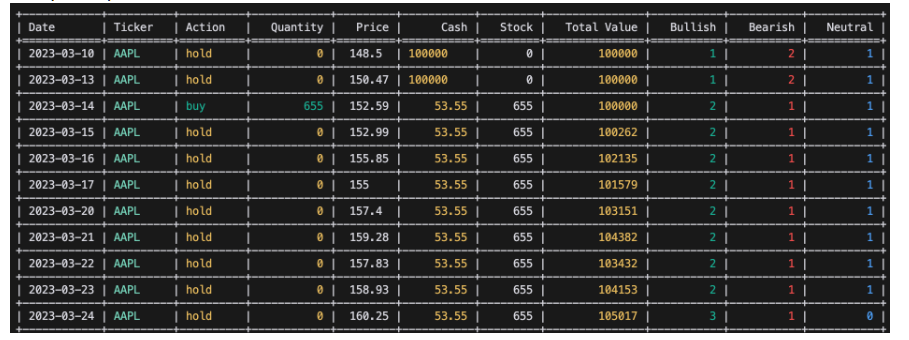
The same blogger ran a broader test on 10 stocks — and 7 came back with a “Buy” recommendation. LLMs have a built-in optimism bias; risk awareness clearly falls short. Let’s be honest: this is still a lab product, far from ready for real trading.
The project’s GitHub page says it plainly: “For educational purposes only. Not for real trading.”
The Real Value Isn’t “Getting Rich”
The biggest value of this project isn’t giving you an “AI stock-picking crystal ball.” It’s showing you the frontier of possibility for AI agents in financial decision-making.
It lets you see simultaneously what Buffett thinks, what Munger thinks, what Cathie Wood thinks, what Taleb thinks — and what you discover isn’t “the right answer.” It’s a debate. And that’s actually the most valuable part: you don’t hear one voice; you hear the collision of multiple perspectives.
“No idea if it’ll make money. But at least I learned some agent framework skills.” — GitHub commenter
Tech Stack and How to Run It
Technically, the project uses LangGraph to orchestrate the multi-agent workflow, Python + FastAPI for the backend, and React + TypeScript with React Flow for a visual workflow editor on the frontend — so you can drag and drop agent nodes to build your own strategy graph, like assembling blocks.
If you have any coding background, getting it running is surprisingly quick:
- For users in China, DeepSeek is a great option — cheap and excellent at understanding Chinese context
- The project also supports Ollama for local models, so you can run it completely offline
What impresses me most about ai-hedge-fund isn’t how “accurate” it is. It’s that it has extracted investing wisdom from books and turned it into code you can talk to, run, and learn from.
Can you replicate investment philosophy? Yes. Can you replicate investment results? No. But with this tool, you can at least hear what Buffett, Munger, and Taleb each have to say about the same stock — and that is the coolest way to learn in the AI era.