 By peter_lzh
 no-ai-slop: The 2,700-Star Open-Source Skill That Strips the “AI Flavor” Out of Your Writing
You read an article and every word makes sense, every sentence is correct — yet something feels off. Too smooth, too correct, too perfect. Like a pre-packaged meal: nutritionally complete, but missing the fire of a real kitchen. That feeling is what people call the “AI flavor,” and no-ai-slop is an open-source project built specifically to remove it.
There’s a saying in the international creator community: AI content is cheap to write and expensive to read. When you hand readers an unfiltered draft, you’re offloading the cost of editing onto them. Keeping your writing from looking AI-generated isn’t aesthetic snobbery — it’s basic decency.
The person behind that line is Peter Yang. In early July he open-sourced his entire rulebook for de-AI-ifying text under the name no-ai-slop — “slop” being those AI-generated pieces that read fluently but say nothing. The project isn’t software; it’s two text files: a set of rules and a self-check list that plug straight into Claude Code or Codex. Less than three weeks after the repo went up, it had earned more than 2,700 GitHub stars, and the launch post on X pulled 610K impressions. Fully open source under the MIT license.
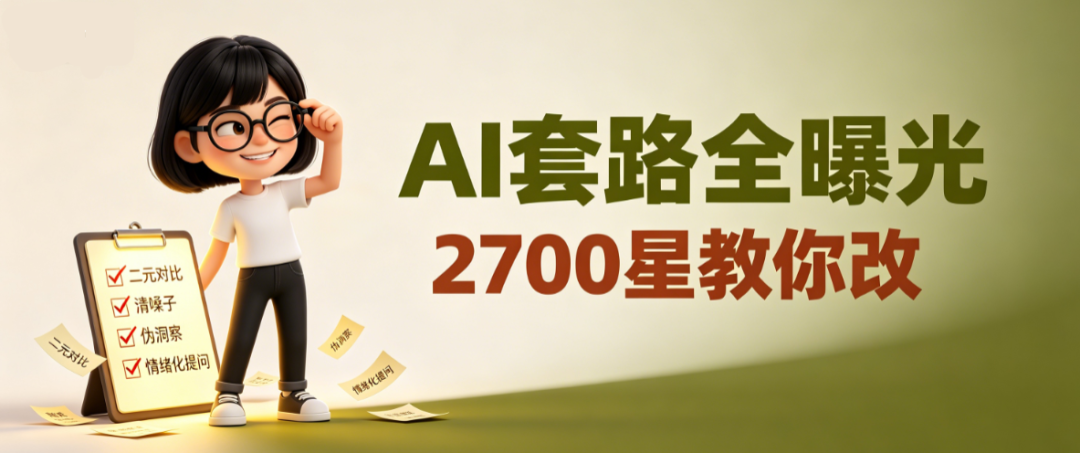
It Doesn’t Guess Whether You Used AI — It Names Every Cliché, One by One
no-ai-slop works in two modes.
The first is editing. Paste in your draft and it follows a “minimum effective edit” principle — it removes only the AI flavor and leaves your personal style untouched. You get back a revised version plus a “What changed” note explaining every edit.
The second is detection. Ask it “was this written by AI?” and it won’t spit out a probability like “87% AI.” Instead, it lists every pattern it caught, quotes the exact sentence from your text, and suggests a fix.
The author states the design philosophy bluntly: AI detectors guess; naming the pattern gives you evidence you can verify. Commercial detectors are black boxes — you get flagged as “likely AI” with no way to appeal. no-ai-slop flips that: it never judges who wrote the text, it only points out “this sentence is a binary-contrast cliché” or “this opening is throat-clearing” — original sentence quoted, so you can check it yourself. That single move turns AI detection from a guessing game into a checklist you can edit against.
20+ Patterns That Scream “AI Wrote This”
The project tracks more than 20 patterns. Any single one looks harmless in isolation, but when they pile up, the AI flavor hits you in the face. The full table lives in the project’s SKILL.md file, with quoted example sentences for each pattern — and you can use it in reverse, as a self-review checklist after you finish a draft.
The 25/50/25 Rule: Humans at Both Ends, AI in the Middle
Peter Yang isn’t against writing with AI — he’s against letting AI do all of it. His proposed workflow is the 25/50/25 rule:
- First 25%: dictate or draft yourself, no AI. Your roughness, opinions, and speaking rhythm live here.
- Middle 50%: edit with AI, run no-ai-slop, cut the redundancy and awkward passages.
- Final 25%: turn the AI off and finalize line by line. This is where your voice sets.
In his words: the difference between people who care about the first and last 25% and people who churn out slop is exactly that — caring.
The framework maps cleanly onto coding, too: the first 25% is your taste defining the requirements, the middle 50% is AI producing in bulk, and the last 25% is you verifying and polishing. Humans at both ends, AI in the middle — possibly the most practical collaboration principle available right now.
Watch Out for the Dark Side
Yang admits that letting AI do everything is dangerously easy — he even caught himself unwilling to write on a long-haul flight without AI, which he calls his biggest warning sign. Crueler still: mass-producing AI slop genuinely grows an audience. But he warns that anyone fluent in AI can smell AI flavor from miles away. A post can rack up beautiful numbers while quietly burning through trust. When Airbnb founder Brian Chesky’s account was hacked and AI-generated posts went out, readers identified them before any official confirmation. Readers aren’t stupid.
One Caveat: It’s Built for English
The no-ai-slop rules target English writing. Its banned-word list — “delve,” “leverage” — doesn’t transfer to Chinese, which has its own AI vocabulary: “赋能” (empower), “闭环” (closed loop), “对齐” (align), “颗粒度” (granularity). What transfers is the method, not the word list: build a verifiable checklist of your language’s AI tells, then pair it with the same principle — minimum effective edits that never sand off the author’s voice.
In the end, what makes a piece of writing good was never smoothness — it’s whether there’s a human in it. Tools will keep iterating; that standard won’t change.
Project Repository
GitHub: github.com/petergyang/no-ai-slop