 By peter_lzh
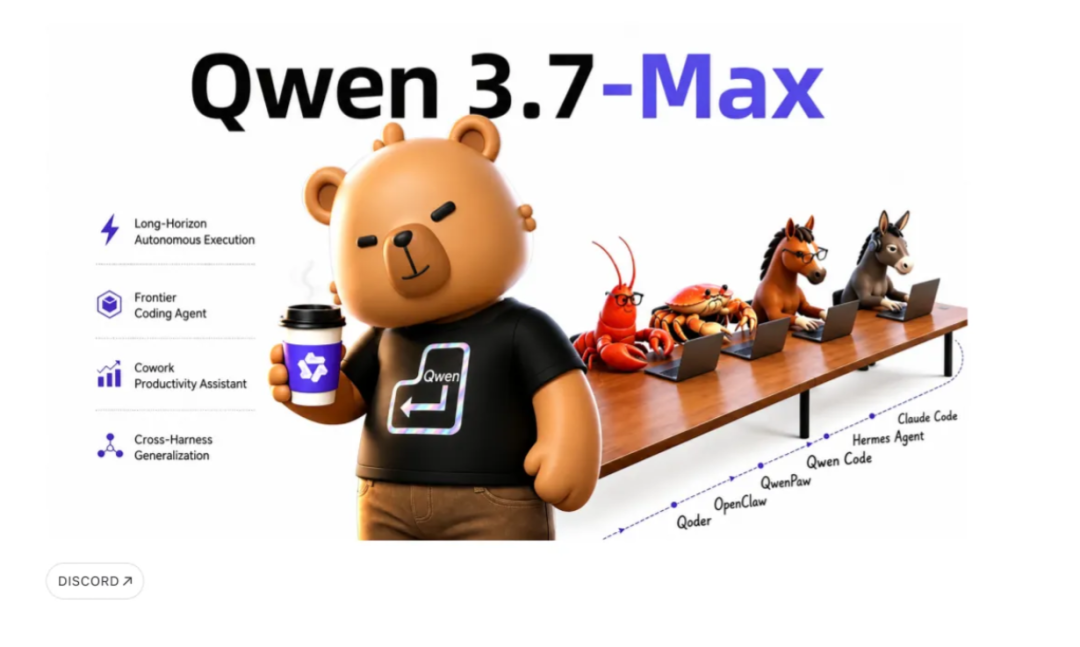
 At the Alibaba Cloud Summit on May 20, Qwen3.7-Max topped the Arena global blind test leaderboard as the #1 Chinese model. Less than a week later, the team dropped a small-but-mighty update: Implicit Caching is now live for Qwen3.7-Max.
One sentence summary: You do nothing. API calls automatically get faster and cheaper.
What Is Implicit Caching?
In simple terms, Qwen3.7-Max now automatically detects repeated content in your requests on the backend, caches the common prefix, and the next time the same prefix appears, it no longer recomputes it from scratch.
Here’s an example: you build a customer service bot with a system prompt like “You are a professional financial advisor. Please answer user questions in a professional yet easy-to-understand manner.” That 50-character prompt is sent identically with every request. Previously, it was recomputed every single time, and you were billed for the full token count every time.
With implicit caching, the system automatically recognizes “Hey, I’ve seen this before” and directly reuses the previous computation result. For the cached portion, token billing drops to just 20% of the original price.
The key point: this feature is enabled by default and cannot be turned off. Zero configuration, zero code changes, effective immediately upon release.
Honestly, this kind of “silent optimization” matters more to developers than launching another new model. No matter how capable a model is, paying $2 per call versus $0.40 makes a world of difference at scale.
Not Just Cheaper — Faster Too
The speed boost from caching isn’t a vague “feels faster” — it’s a concrete reduction in computation.
Context caching essentially skips the attention computation and KV cache generation for the common prefix portion. This means lower GPU utilization, higher throughput, and shorter time-to-first-token (TTFT).
For developers, reduced TTFT directly improves user experience — going from waiting 3 seconds to 1 second when opening an AI conversation is a completely different feel. In Agent scenarios, this acceleration is even more valuable: Qwen3.7-Max is positioned as an Agent model, and a single task might make dozens or even hundreds of API calls. Saving 0.5 seconds per call means a task could finish tens of seconds faster.
Implicit vs. Explicit Caching: Which to Choose?
Implicit caching isn’t the only option. Qwen actually offers two context caching modes, and they’re not limited to Qwen3.7-Max — models like DeepSeek, Kimi, GLM, and MiniMax deployed via Bailian also support them:
| Feature | Implicit Caching | Explicit Caching |
|---|---|---|
| Configuration Required | Auto, zero config | Manual cache_control markers needed |
| Hit Certainty | Uncertain, system decides | Guaranteed (100% within 5-min TTL) |
| Hit Token Billing | 20% of input price | 10% of input price |
| Min Cache Tokens | ~1000 (Qwen3.7-Max) | 1024 |
| Best For | Daily chat, fixed system prompts | High-frequency queries, deterministic scenarios |
Both modes have their strengths:
- Implicit caching wins on zero mental overhead. You write your code, the system saves you money. Great for most scenarios, especially fixed system prompt + dynamic user query patterns.
- Explicit caching is more precise and cheaper (10% vs 20%) but requires manually adding
cache_controlmarkers in your code and managing the 5-minute TTL.
The two modes are mutually exclusive — a single request can only use one. If explicit caching hits, implicit caching won’t intervene.
How Much Can You Actually Save? Let’s Crunch the Numbers
Suppose your application is a typical customer service chatbot: a system prompt taking 2,000 tokens, each user query averaging 500 tokens, 10,000 calls per day.
- Without caching: Daily input tokens = (2,000 + 500) × 10,000 = 25 million tokens.
- With implicit caching (system prompt hit): The 2,000-token system prompt is billed at 20%, equivalent to 400 tokens. Daily input drops to (400 + 500) × 10,000 = 9 million tokens — a 64% savings.
In multi-turn conversation scenarios where history messages are also cached, savings are even larger. The Alibaba Cloud documentation gives a more intuitive example: a 10,000-token request with 5,000 tokens hitting the cache (billed at 20%) means the total input cost is only 60% of the no-cache scenario.
A Practical Optimization Tip
Want to maximize implicit cache hit rates? Remember one rule: put fixed content first, variable content after.
✅ Good practice: system prompt first (fixed)
messages = [
  {"role": "system", "content": "You are a financial advisor..."},  # Fixed → cached
  {"role": "user", "content": user_query}                           # Variable → after
]
❌ Bad practice: variable content first
messages = [
  {"role": "user", "content": user_query},                          # Variable → breaks prefix match
  {"role": "system", "content": "You are a financial advisor..."}  # Cache can't hit
]
If you’re using a vision model (Qwen3-VL), the rule is slightly different: when asking multiple questions about the same image, put the image first; when asking the same question about different images, put the text first.
An Update You Didn’t Know You Needed
Qwen3.7-Max’s implicit caching is essentially a “win without lifting a finger” feature — no action required on your part, the system automatically saves you money and speeds things up. You don’t even need to know it exists; your bill is already getting a discount.
At a time when AI applications are shifting from “does it work?” to “is it worth it?”, this kind of infrastructure-level cost optimization is more practical than beating another benchmark.
If you’re already building products with Qwen3.7-Max, good news — your bill just got discounted automatically. If you’re still on the fence, this might be the extra nudge to make the switch.
References
- Official Announcement: https://x.com/Alibaba_Qwen/status/2058932656797368619
- Alibaba Cloud Context Cache Docs: https://help.aliyun.com/zh/model-studio/context-cache
- Qwen3.7 Launch Blog: https://www.alibabacloud.com/blog/qwen3-7-the-agent-frontier_603154