 By peter_lzh
 Over the past year, AI video tools have flooded the market. But almost all of them hit the same wall: character inconsistency.
You spend hours writing a script, generate the first shot of your male lead, then cut to the next angle — and he looks completely different. Different hair, different clothes, sometimes a different age. This “every shot, a different person” problem has kept AI short dramas stuck in the “just for fun” phase.
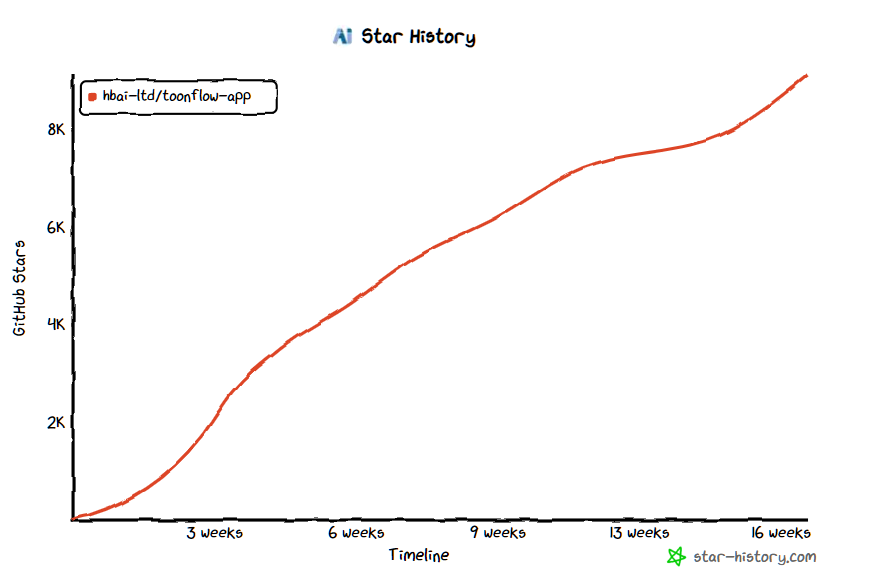
But a recent open-source project genuinely surprised me: Toonflow. Nine thousand one hundred stars on GitHub, developed by Beijing Ai-A Technology — a one-stop AI short drama factory.
Its core philosophy isn’t “single-shot high-quality generation.” It’s about turning AI short drama production into a reusable, industrialized assembly line.
From Gacha to Assembly Line: What Toonflow Got Right
Anyone who’s used AI image or video tools knows the drill: write a prompt, hit generate, and hope. Sometimes you get lucky. Most of the time, you hit retry.
Toonflow takes a fundamentally different approach. It builds a complete closed loop around Plan → Script → Storyboard → Output. The process breaks down into three steps:
Step 1: Character ID Card. After importing your text, the AI automatically extracts your protagonist’s appearance, clothing, facial features, and builds a “character identity card.” This card follows every single shot, ensuring the same character looks identical from episode 1 to episode 100. If the AI’s extraction isn’t perfect, you can manually tweak the keywords.
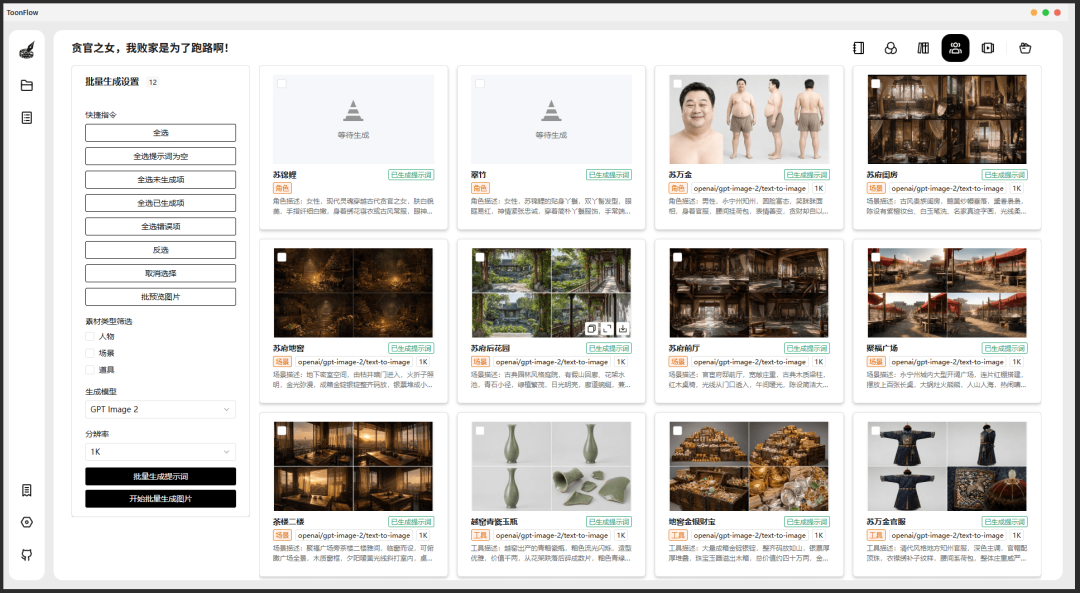
Step 2: Smart Storyboarding. The system automatically decomposes your script into individual shots, generating storyboard images and frame compositions. This replaces the most time-consuming phase in traditional animation — manual storyboard drawing. If the AI messes up hands or fingers, there’s a built-in Inpainting tool to fix them directly.
Step 3: Video Conversion. Hook into video generation models like Seedance 2.0 to turn static storyboard images into dynamic video clips. Paired with the built-in infinite canvas workspace, all your assets, storyboards, and video nodes can be freely arranged and backtracked.
Through this pipeline, work that traditionally took days gets compressed into tens of minutes — easily a 10x efficiency boost.
A Three-Agent Architecture Worth Studying
What impressed me most about Toonflow is its Agent architecture design.
Unlike simple “input → AI call → output” tools, Toonflow deploys a three-layer Agent collaboration system:
- Decision Layer Agent: Handles task decomposition and strategy planning — decides how many scenes the script needs, what visual style to use.
- Execution Layer Agent: Actually calls AI models to generate characters, storyboards, and video.
- Supervision Layer Agent: Quality review — catches issues and auto-flags them for correction.
Even more impressive: it includes a persistent memory system based on ONNX local vector retrieval. Agents remember creative context across sessions — character settings and scene styles from your last project are still there when you reopen it. For creators running ongoing series, this is a game-changer.
The programmable provider system also deserves a mention: you can write TypeScript logic in the settings panel to connect new AI service providers. Changes take effect instantly — no source code edits, no restarts. For creators juggling multiple LLM subscriptions, this is a productivity flywheel.
$18 for a 2-Minute Drama: How the Math Works
Hearing “AI short drama” makes many people think “expensive.” But Toonflow’s official demo gives real numbers:
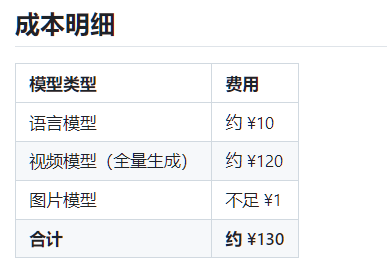
- Claude Opus 4.6 for scriptwriting — about $1.40
- GPT Image 2 for storyboard images — less than $0.15
- Seedance 2.0 for video generation — about $16.50
Total: roughly $18 to produce a 2-minute AI short drama in under 2 hours.
Yes, these are ideal-condition numbers. In practice, you’ll probably run a few extra generations and discard some material. But even at double the cost — $35 for a 2-minute short drama — that’s a price traditional film production could never dream of.
And it’s open source — the software itself is free. You only pay the model providers’ API fees. Compared to online AI video platforms charging $28/month or more, the cost structure is incredibly friendly for creators producing at scale.
The Bottom Line
Toonflow solves a core problem: it turns AI video from “one-off creation” into a reusable industrial workflow.
Character consistency control, Agent collaboration, persistent memory, programmable providers — none of these features are for show. They deliver real, measurable gains in batch production efficiency.
If you’re a creator pumping out 10 novel-promo videos a day, or a team looking to rapidly video-fy your IP catalog, this tool is worth an afternoon to run through.
Project: github.com/HBAI-Ltd/Toonflow-app
Website: toonflow.net