 By peter_lzh
 You’ve got 20 Claude Code tabs open. Each agent is working on something different, and you’re tab-hopping, trying to keep track of progress. One agent gets stuck in an infinite loop, burning through tokens — by the time you notice, you’ve already blown through dozens of dollars. Need them to collaborate? Sorry, that’s on you. You have to relay messages manually.
Multi-agent collaboration has been talked about for years. But something that genuinely felt like “this is the right direction” never arrived.
Until Paperclip.
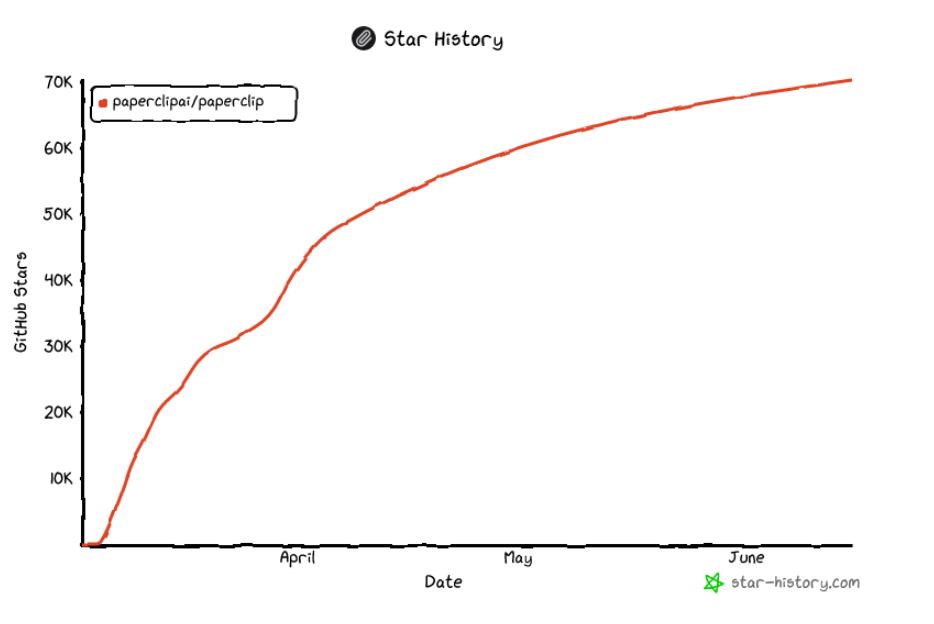
70K Stars in Three Months
Paperclip was open-sourced on GitHub in March 2026.
It’s not a chatbot. Not an agent framework. Not a workflow tool. It’s an operating system for AI agent companies.
In less than three months, it has crossed 70,500 stars and 13,100 forks. What does that tell you? People genuinely need this.
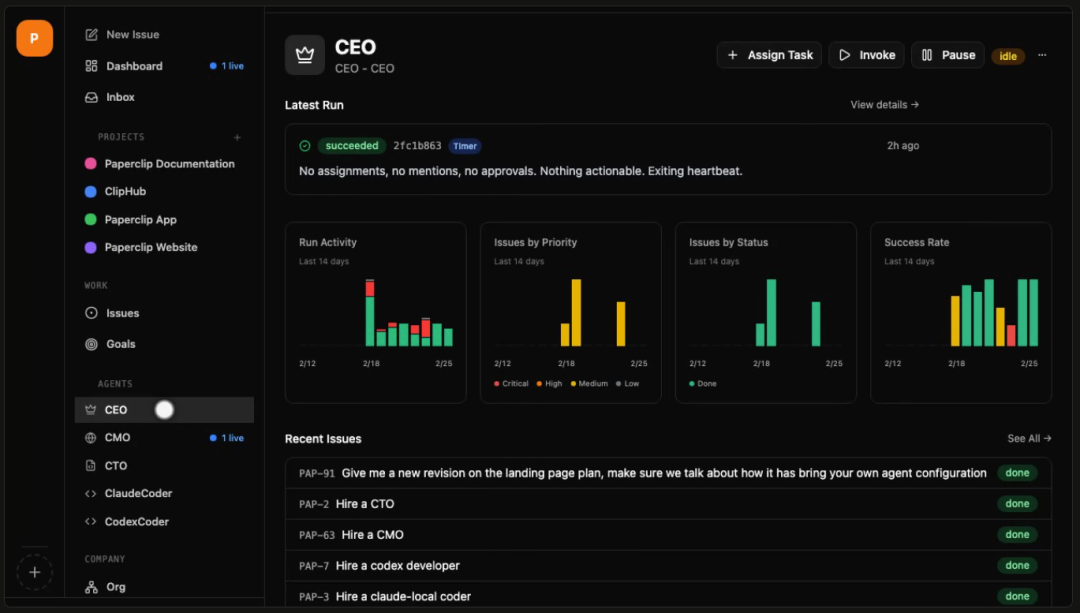
The official definition is remarkably precise:
“If OpenClaw is an employee, Paperclip is the company.”
This isn’t marketing fluff — it’s the core design philosophy. Paperclip doesn’t write code, compose articles, or make decisions. It does exactly one thing: manage the agents that do.
How Do You Actually “Manage” a Team of AI Employees?
Paperclip operates on four layers of management logic:
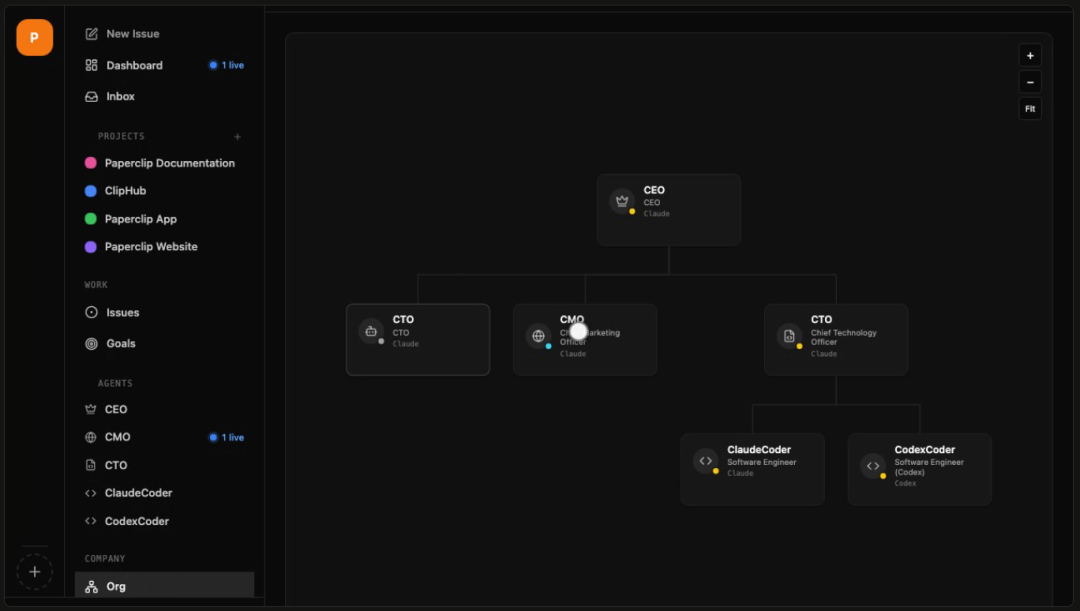
Layer 1: Organizational Structure. Every agent has a position, a superior, and a reporting relationship. The CEO agent aligns direction. Management agents decompose tasks. Execution agents handle delivery. You can “hire,” “fire,” or “reassign” at any time — exactly like managing people.
Layer 2: Goal Alignment. Every task traces back to the company mission. Agents don’t just know what to do — they know why they’re doing it. This prevents the all-too-common failure mode of agents “being diligent about doing the wrong thing.”
Layer 3: Budget Control. This is the most valuable feature. Every agent has a monthly budget. At 80% utilization, it triggers a warning. At 100%, it auto-pauses. Task acquisition and budget checks are atomic operations, eliminating duplicate work and runaway spending.
Layer 4: Governance and Approval. Critical tasks go through an approval chain: AI Agent → Supervisory Agent → Human Administrator. Your role isn’t “operator” — you’re the “board of directors.” All decisions and token consumption are recorded in an immutable audit log.
One developer’s real-world test captured the value perfectly: an engineering agent got stuck in an infinite loop on a vaguely defined task. Within three days, its budget hit 80%, and the system auto-flagged it. He rewrote the task description, and the problem vanished. Without budget controls, that loop would have kept burning money until he noticed — which might have been days later.
Heartbeat: Letting Agents Move on Their Own
The traditional agent interaction pattern is straightforward: you send a command, it executes, you send another command. Fundamentally manual.
Paperclip takes a different approach: agents auto-wake at preset intervals, proactively checking the task queue. If there’s work, they do it. If not, they respond “OK” — costing zero tokens. Task delegation flows automatically through the organizational structure.
This solves a fundamental problem: agents transform from one-shot executors into continuously running nodes. You don’t need to watch the screen. You don’t need to manually decide “who works on what next.”
When your agent team exceeds three and your tasks exceed ten, the value of this automation doesn’t just grow — it multiplies.
Getting Started and Cost
Deployment is a single command:
npx paperclipai onboard --yesThirty seconds to launch. Open http://localhost:3100 in your browser, and you have a fully functional AI company management console.
Paperclip itself is completely free — MIT open source license. The real cost is the token consumption of the underlying models you connect (Claude, GPT, etc.). Here’s the twist: this free tool’s core function is precisely what helps you manage that very real, non-free model spending.
Is It Right for You?
It’s right for you if:
- You’re running three or more always-on AI agents and coordination is getting messy
- You can handle Node.js self-hosted deployment
- You need a “dashboard” to manage costs and tasks across multiple agents
It’s not for you if:
- You only need one agent doing one thing — Paperclip becomes overhead
- You want a zero-config SaaS experience (currently self-hosted only)
- You’re hoping it will make mediocre agents smarter — it doesn’t boost capability, it boosts organizational order
ToolCenter’s review put it best: “Paperclip is the first multi-agent tool that makes me feel like a ‘manager’ rather than a ‘babysitter.’ The unglamorous features quietly prevent disasters.”
The Bigger Picture
The second half of the agent era will shift competition from “individual agent capability” to “multi-agent organizational capability.”
Just as the Industrial Revolution wasn’t merely about inventing better steam engines — it was about inventing the factory system itself. What Paperclip is doing is bringing that “factory system” into the world of AI agents.
From March 2026 to today, 70,000 stars have already proven one thing: this path is one that people genuinely need.
Project: github.com/paperclipai/paperclip
Documentation: paperclip.ing
I totally agree with the article’s emphasis on *budget control* as the most valuable feature—because I’ve been burned by runaway AI costs myself. Just last week, I had an agent iterating on ad copy with vague prompts, and by the time I noticed, it had consumed nearly $200 in tokens on a single experiment. The idea of setting atomic budget thresholds that auto-pause agents at 80% or 100% utilization feels like a game-changer. It’s not just about saving money—it’s about sanity. With Paperclip’s approach, you’re not just managing tasks, you’re protecting your workflow from the silent drain of poorly scoped AI work. That kind of guardrail turns AI from a risk into a reliable team member.