 By peter_lzh
 Dawning 8000: China’s First Fully Domestic 100,000-Card AI Cluster Hits Full Load in Its First Week
On July 18, at the 2026 World Artificial Intelligence Conference (WAIC), the lineup was stellar. This time the “treasure of the exhibition,” Dawning 8000 (Dengfeng), revealed its latest operating data: in its first week online it hit full load, breaking 150,000 jobs processed per day on average, with a single-day peak above 500,000.
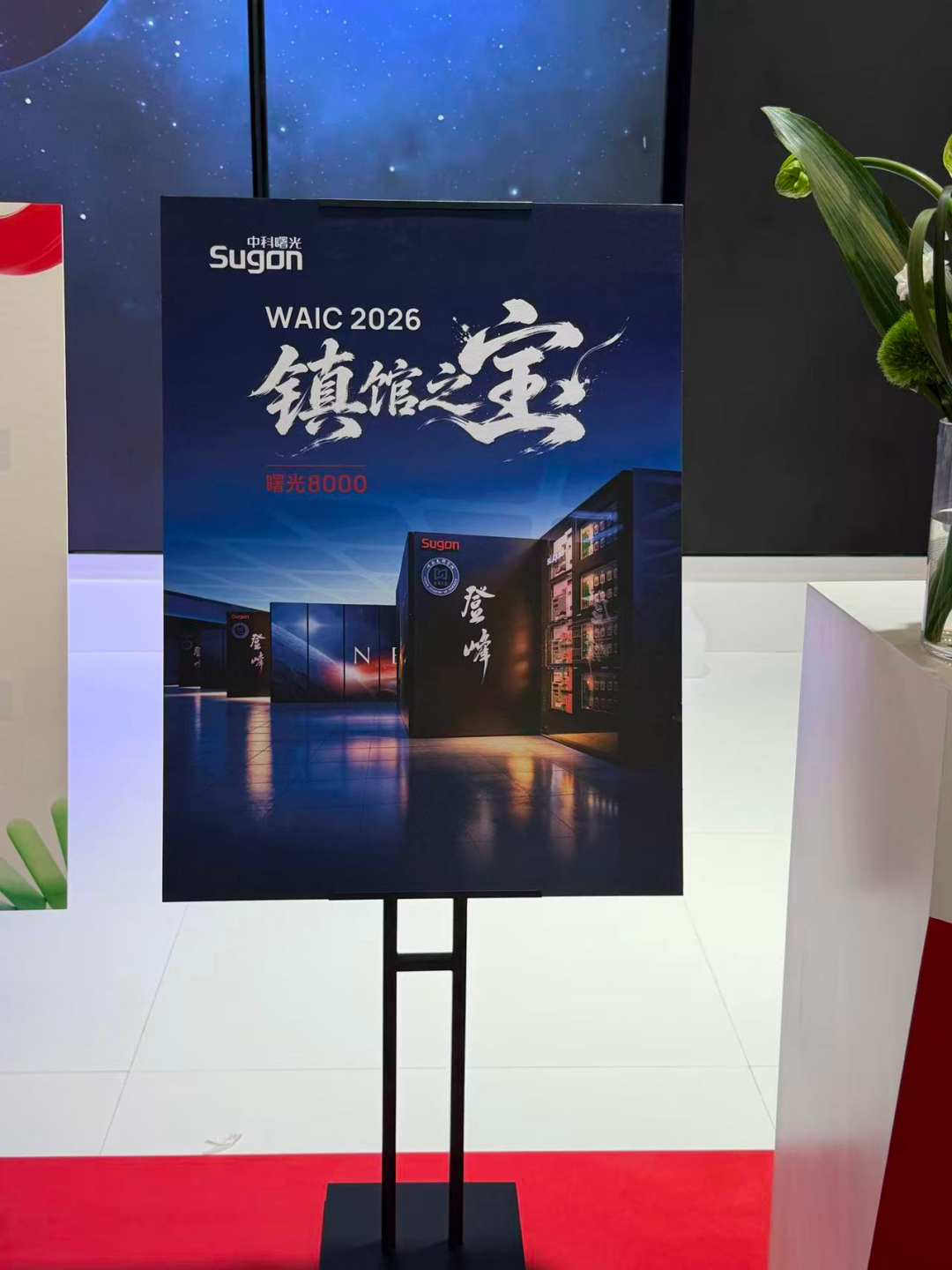
China’s first fully domestic 100,000-card AI super cluster hit full load in its first week online.
Full Load, but No Traffic Jam
When a 100,000-card cluster runs at full load, the first reaction is often: does it jam?
Dawning 8000’s answer is to let the scheduling system absorb the pressure, with an intelligent scheduling engine, data affinity algorithm, and multi-element fusion scheduling strategy. The system looks at task type, where the data is, and how busy resources are, then auto-routes and allocates on demand.
The official wording is “high load without congestion, many tasks without queuing.” Even with millions of concurrent users flooding in, jobs still run.
How the 100,000 Cards Are Stacked
Staying stable at full load in the first week relied not on one particularly aggressive parameter but on the whole system meshing well.
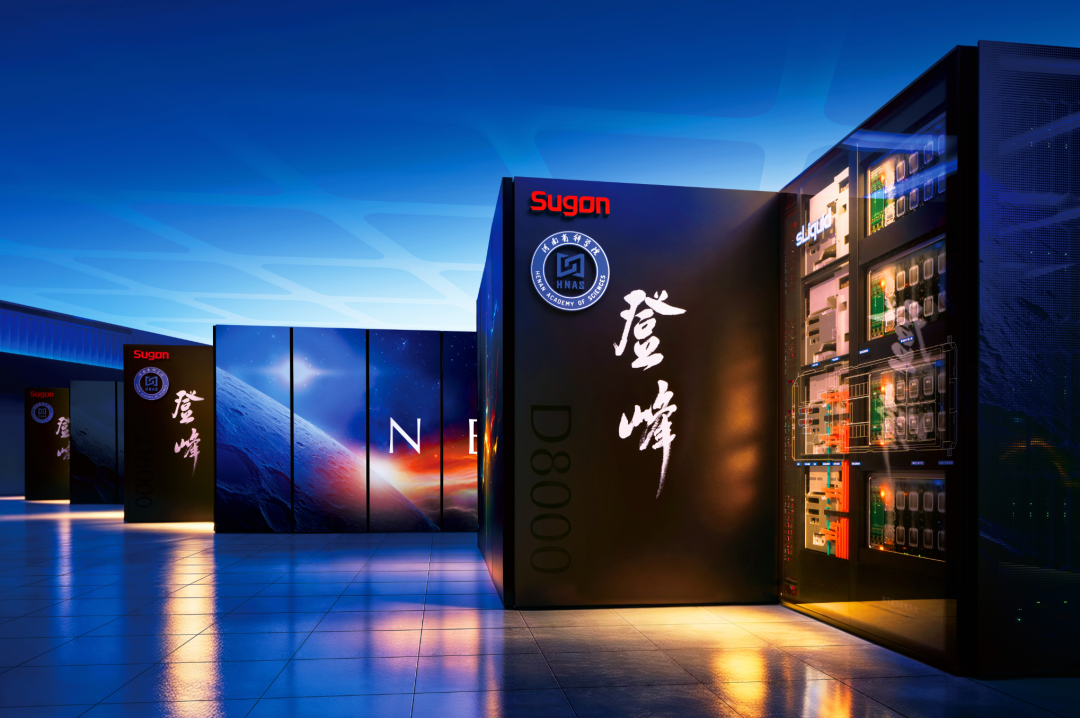
First, density. Dawning 8000 uses the world’s first high-density cabinet structure; a single compute unit’s compute density is 20 times that of other super nodes, packing far more compute into the same machine-room area.
Then interconnection. A self-developed scaleFabric class-IB native RDMA lossless interconnect, China’s first native lossless RDMA ultra-high-speed network: a single subnet supports 114,000 cards, end-to-end NIC latency below 1 microsecond, switch forwarding 260 nanoseconds, single port 800G, total switch capacity 64Tbps. Scaling the cluster from 10,000 to 100,000 cards keeps the network stable, and link failures self-heal in milliseconds.
At the base are 6 self-developed domestic core chips, covering general-purpose processors, AI acceleration chips, and interconnect switch chips. The whole machine, high-speed network, and scheduling software are fully localized, with comprehensive performance described officially as “international advanced level.”
In compute precision, it fully supports FP64, FP32, BF16, TF32, FP8, and INT8. High-precision scientific engineering computing and AI training inference can run in parallel on the same base, which Dawning calls “native super-intelligence fusion.”
Storage uses the ParaStor distributed storage system, which took two global performance first places on the 2026 IO500 list, production full-node and 10-node. Storage scales with however many nodes you add.
Cooling and power are also notable: immersion phase-change liquid cooling plus high-voltage DC power, year-round natural cooling, PUE as low as 1.04, system availability 99.99%, with waste heat recoverable and no water consumed.
What Are All These Cards Computing
So far, Dawning 8000 has completed nearly a thousand super-intelligence-fusion application adaptations, covering large-model training, high-throughput inference, scientific computing, and many 10,000-card-scale scenarios.
More concretely: over 300 key applications received deep optimization, 65 adapted at half-machine scale, 20 at full-machine scale, and 15 reaching the Gordon Bell Prize-scale super-large simulation standard, spanning more than 20 mainstream research and industry fields.
A few representative cases:
- Quantum computing: 80,000 cards completed high-precision ground-state energy calculation of a 152-spin-orbit FeMoco cluster.
- New materials: 90,000 cards achieved 3.16-trillion-atom DFT high-precision simulation.
- Fluid simulation: 88,000 cards completed direct simulation of 328-trillion-grid turbulence.
- Biology: 80,000 cards accelerated full-process protein folding simulation.
- Meteorology: developed and deployed a next-generation weather large model based on the SwinUNet framework.
- Energy: ported a seismic imaging core algorithm to a domestic platform, adapting to CNPC BGP’s oil and gas exploration scenarios.
On the large-model side, mainstream scenarios such as language, speech, multimodal, and autonomous driving are all adapted, with training, fine-tuning, and inference all runnable end to end. The SothisAI platform has connected domestic mainstream models such as Zhipu GLM-5 and Alibaba Qwen3.5. The research-oriented OneScience platform goes further, simplifying model development into natural-language dialogue, and has served more than 20 key research institutions.
After Connecting to the Supercomputing Internet
Dawning 8000 does not run behind closed doors; it connects to the Supercomputing Internet and quickly became a core node.
First the platform’s assets: over 1.4 million registered users, over 11.3 million average monthly visits, 240 million jobs completed cumulatively, over 290,000 jobs processed per day on average.
After Dawning 8000 connected, with 150,000 per day in the first week and a single-day peak of 500,000, it pushed the whole platform’s daily processing above 450,000.
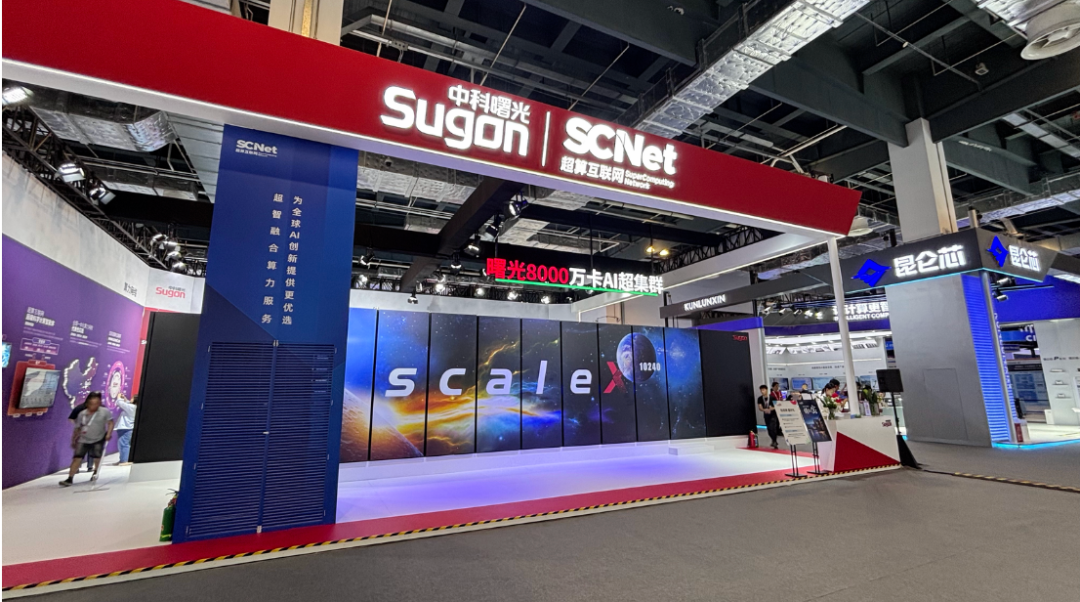
On resources, the Supercomputing Internet links more than 30 supercomputing and AI centers across 14 provinces and regions, aggregating a heterogeneous pool of over 3.5 million CPU cores and over 250,000 GPU acceleration cards. The Dawning 8000 100,000-card cluster is currently the largest single-node domestic AI compute resource in China.
On applications, the platform has adapted over 1,600 open-source large models, over 600 images, and over 1,000 knowledge bases, over 690 datasets, over 300 agents, and over 17,000 Skills.
Three Ecosystem Plans
Alongside Dawning 8000’s deployment, the platform launched three co-build ecosystem plans:
100,000-Card Co-Creator Incentive Plan: for university research teams, tech startups, and industry R&D institutions, offering tiered compute subsidies, exclusive scheduling resource priority for the 100,000-card cluster, and free access to industry datasets. Benchmark projects can open 10,000-card-scale exclusive compute quotas with full-process technical support.
Agent Ecosystem Co-Creation and Recruitment Plan: the platform now has 276 self-developed and connected scientific agents, covering materials, bioinformatics, meteorology, industrial simulation, geoscience, and literature, six fields, recruiting developers to co-build industry agents. Finished agents can be deployed on Dawning 8000 to go live and be open to the platform’s 1.2 million-plus registered users.
Core Ecosystem Partner Recruitment Plan: upstream and midstream vendors of chips, whole machines, storage, network, liquid cooling, and power, as well as professional simulation software and industry large-model service providers, can apply to join. After adaptation, products enter the Supercomputing Internet app mall, which already has 7,294 application products and 793 service providers.
In Closing
Full load in the first week, nearly a thousand adaptations, no traffic jam under high load: these three things point to the same change. With giant AI infrastructure, people are starting to look not at scale but at service.
Dawning 8000’s first-week data at least shows one thing: a fully domestic 100,000-card super cluster can absorb real research and industry tasks. What is more worth watching next is whether this state can keep running.
Source: 2026 World Artificial Intelligence Conference (WAIC), Sugon (中科曙光).