 By peter_lzh
 Qwen3.8-Max-Preview Hands-On: A 2.4T-Parameter Model That Debugs Its Own Code
China’s domestic models have been shipping at a furious pace lately — a new one seems to arrive every few days, and honestly it is exciting. Over the past few days, many readers have asked me to put Alibaba’s latest model, Qwen3.8-Max-Preview, through a real test.
Although it is still a preview, its parameter count has already reached 2.4T, and the team claims it is “possibly the strongest model except Fable 5.” That statement only made everyone more curious to see how it actually performs.
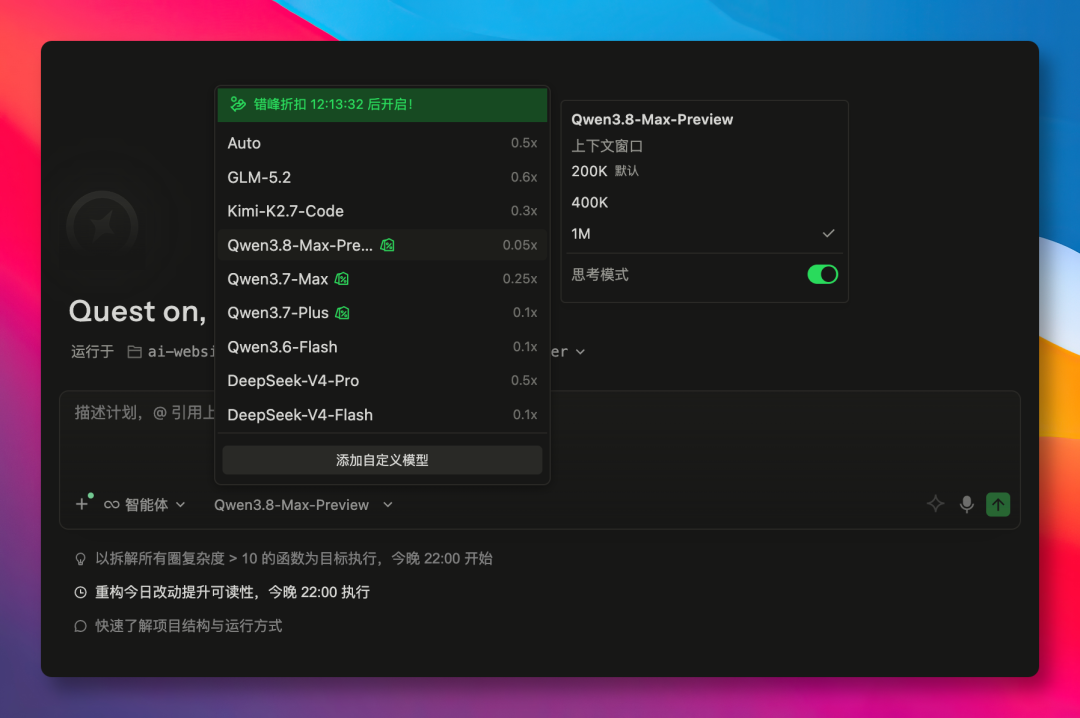
Today I found time to run two real tasks: one to test whether it does solid work, and one to see what creative tricks it can pull off. This time I ran the test on the CN version of Qoder — the model works right out of the box, with no need to fiddle with connecting Claude Code.
Cloning a Website
A while back I shared a skill that can clone any website: ai-website-cloner-template. To achieve the best possible replication, it scrapes all the content of an entire site and then rebuilds it.
This heavily tests a model’s long-horizon task handling and front-end coding ability — a perfect way to check out Qwen3.8’s performance. To push it to the limit, I chose to clone the Bun official site, which has animated interactions, complex page structure, and plenty of icon and video assets.
With a single command in Qoder, Qwen3.8 invoked the clone-website skill, broke the job into 6 tasks, and started working through them in order.
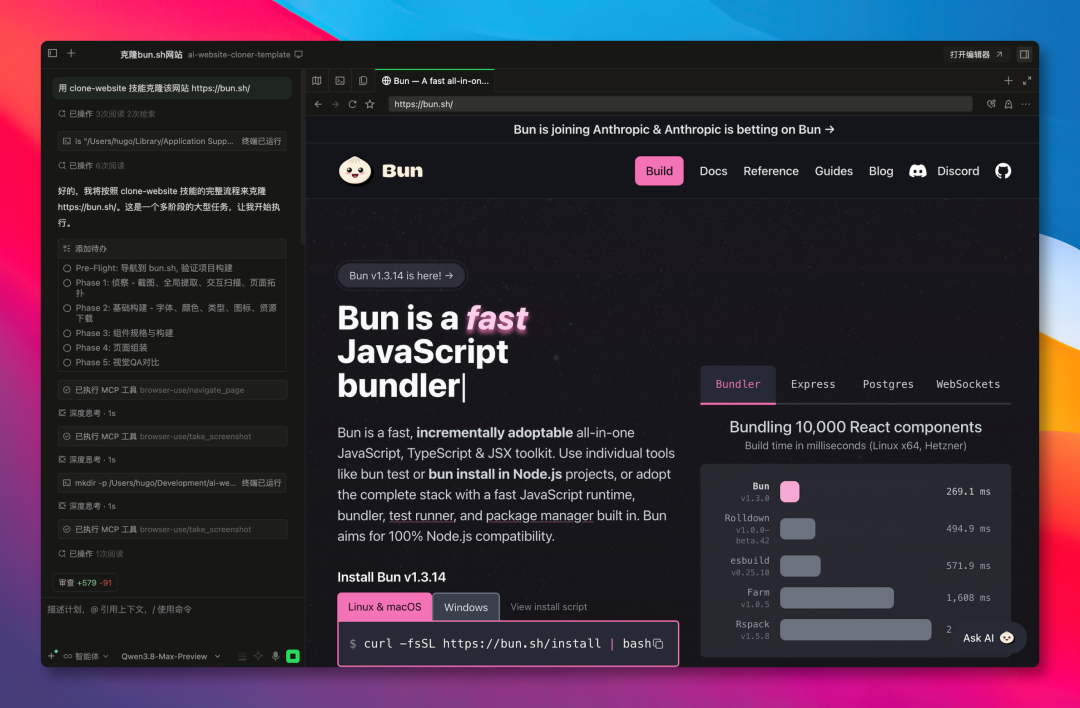
Qoder also has a built-in browser, so the skill can open web pages for side-by-side replication without launching Chrome separately. I have to say, since not many people seem to be using it yet, the model responds very fast. Let’s look at the comparison directly:
It is almost a one-to-one replication — fonts, colors, and animation details on the page are all faithfully reproduced, and even the videos were included. It is clear that Qwen3.8 is strong across multimodal understanding, decomposing complex tasks, and coding development.
Generating a 3D Game
Ever since Fable 5 and GPT-5.6 came out, many people have used them to build all sorts of 3D game scenes. So I tested Qwen3.8 as well, asking it to build a “3D drift racing” game using Three.js.
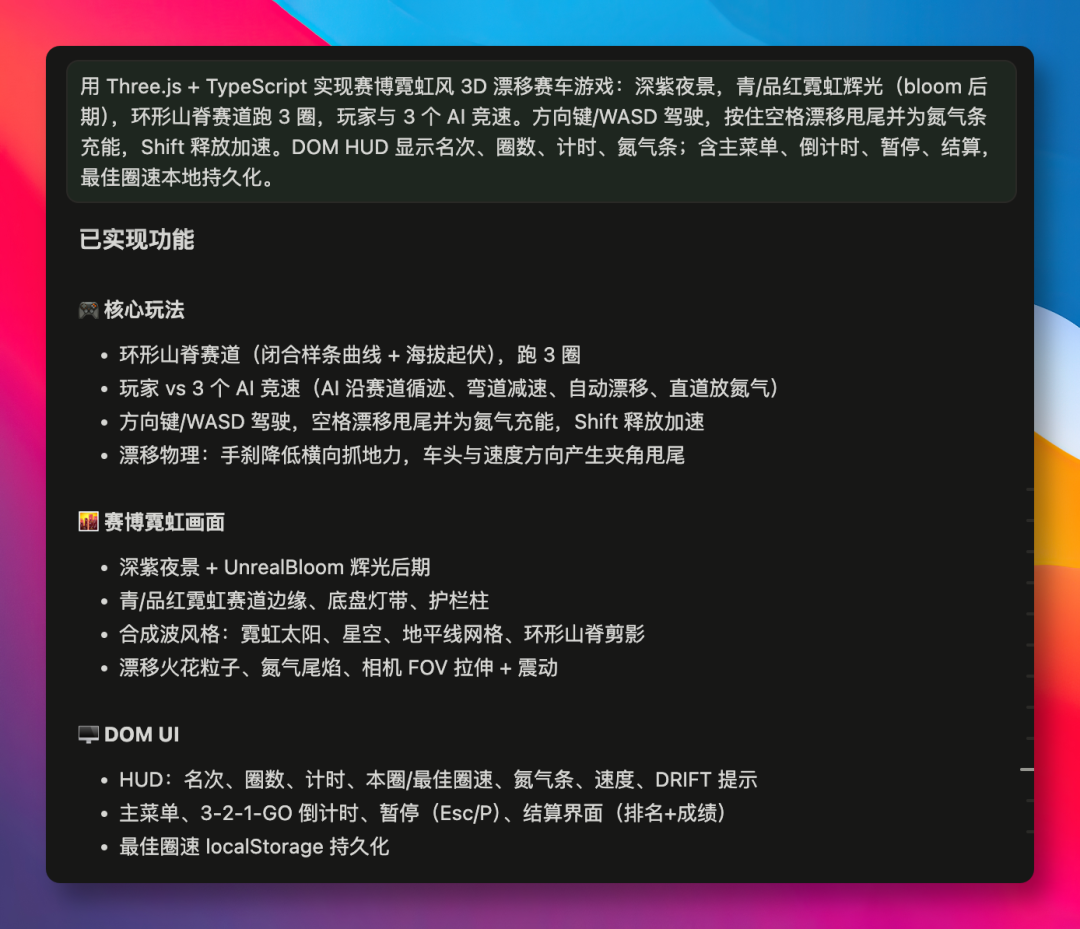
The model implemented it quickly, but while playing I found the screen would go black when the car reached a certain part of the track. Honestly, at first I thought it would be hard for the model to precisely fix this bug, since I could only describe the problem vaguely.
In the past, when a bug appeared, there was an error log to hand to the model. Now I could only describe the issue vaguely, which places high demands on the model’s ability to investigate, analyze, and fix code. But to my surprise, Qwen3.8 actually launched a browser itself, played through the game, found the problem, and fixed it.

This capability is genuinely useful in real project development, especially for problems that have no logs and are hard to describe. Here is the final game — I played a round, and after trying it I think it is already quite good: the overall 3D effects and vehicle handling are well designed, with deceleration into corners, drifting through sharp turns, nitrous boost, and even sound effects.
After running these two long, complex tasks, I also glanced at consumption, and it was far cheaper than expected. I then discovered Qwen3.8-Max-Preview is running a limited-time discount that started on July 19.
During regular daytime hours (08:00 to 22:00), it is a flat 90% off, with credit consumption dropping from 0.5x to 0.05x. During off-peak night hours (22:00 to 08:00 the next day), it is even steeper — as low as 0.2 of the original rate, equivalent to saving 98% of credits.
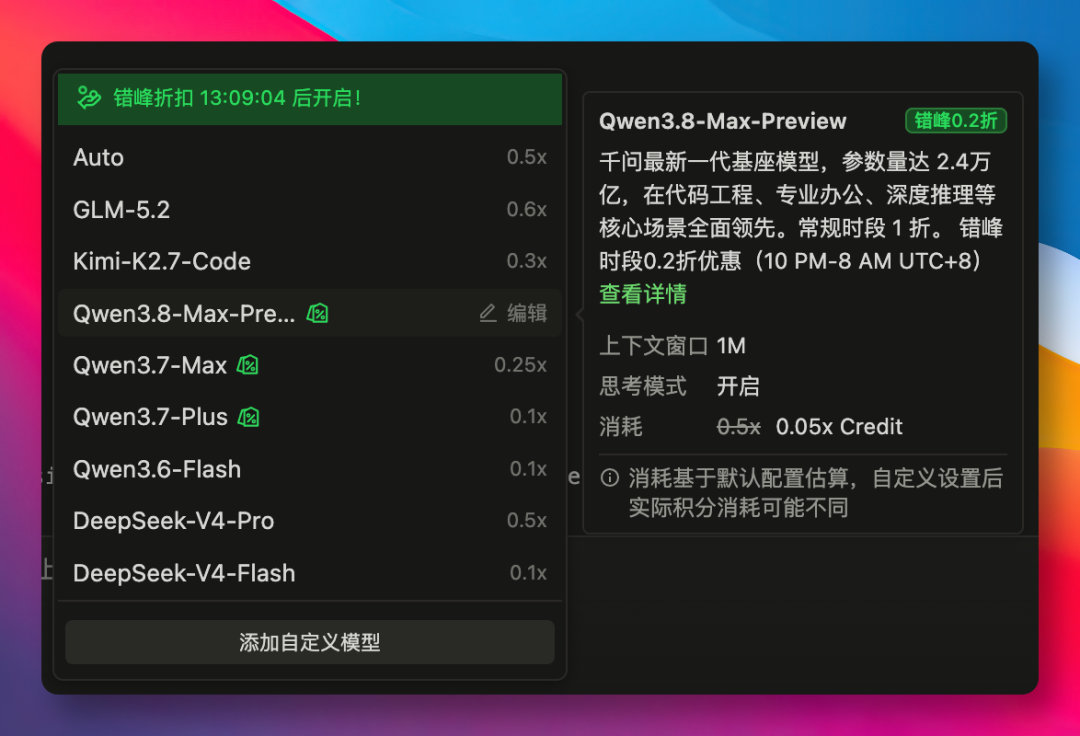
Moreover, Qoder’s entire product line — desktop, CLI terminal, and app — can all enjoy this Qwen3.8 offer. New users also get a 14-day trial and 300 credits on first login, so you can get hands-on with Qwen3.8 first.
Final Thoughts
Looking back at this test, not every task was completed in one shot — the racing game had problems in its first version. But it was precisely that bug that showed me something more valuable than “getting it right the first time”: the model can open a browser itself, verify whether the implementation works, and identify the bugs in its own code.
In my view, more than parameter count, the ability of a model to verify things by itself brings us closer to real productivity. Going forward, what may separate models from one another is who can carry a job from start to finish and deliver it successfully.
I have also strongly felt lately that domestic models are growing ever more capable, and can genuinely go toe-to-toe with the world’s top models. As for Qoder, it works quite well as a coding tool, with a built-in terminal, browser, and editor — an overall experience similar to Codex. Claude Code is no longer irreplaceable or one-of-a-kind. We can predict that all kinds of domestic AI will keep rising, and the gap between China and the rest of the world will shrink to zero, or even reverse.