 By peter_lzh
 Party OS: RoboParty Open-Sources Its Embodied AI R&D Base for Humanoid Robots
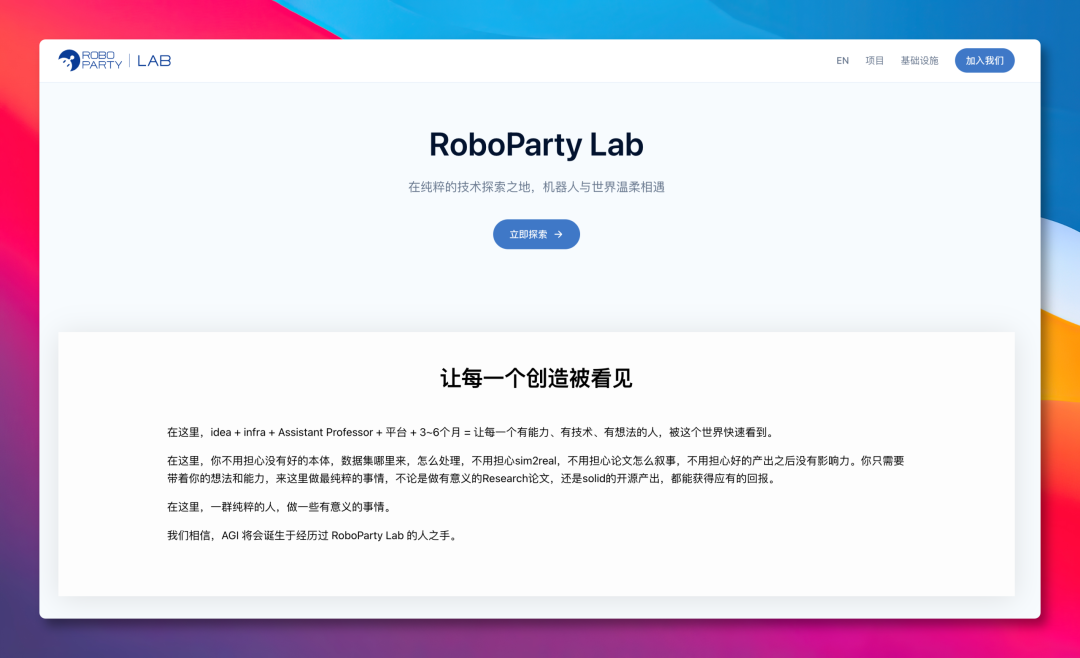
Recently, RoboParty — a globally leading open-source full-stack humanoid robotics platform — publicly released Party OS, an open-source embodied intelligence R&D foundation for next-generation humanoid robots. Alongside it, RoboParty launched RoboParty Lab (RPLab) and brought the lab’s website online.
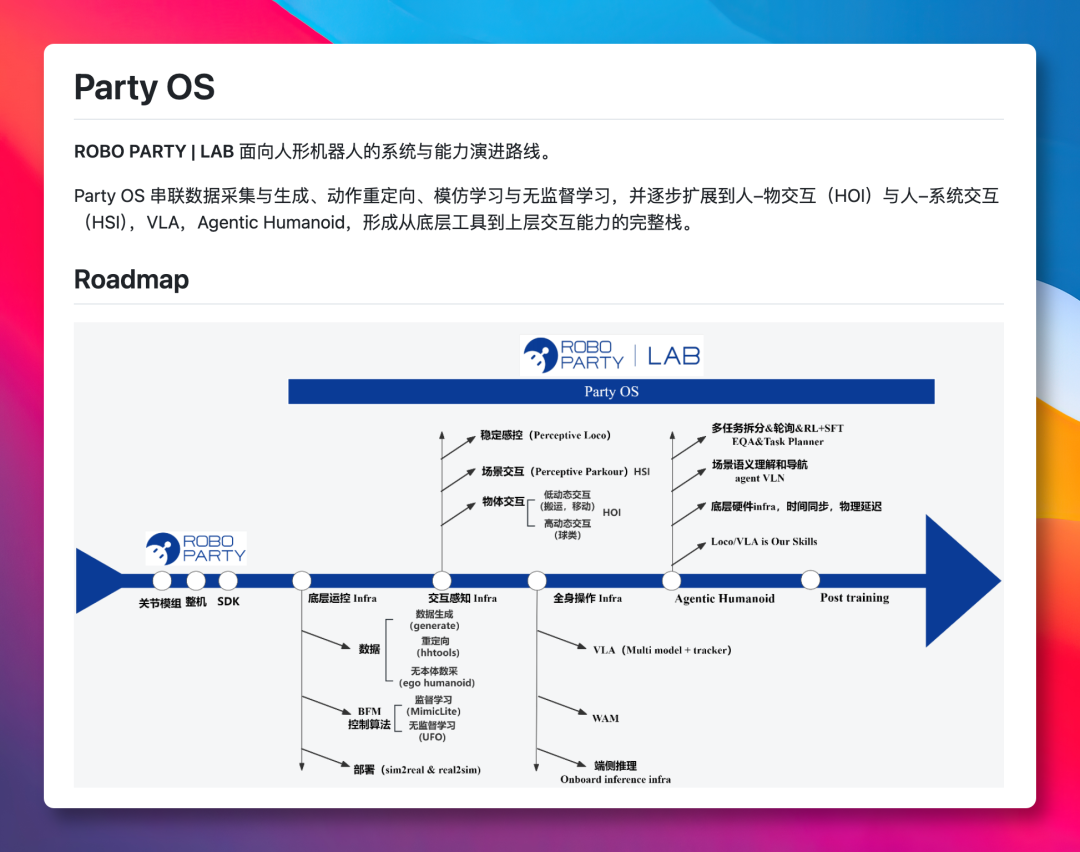
Party OS is not a traditional robot operating system. Rather, it is the open-source embodied infrastructure RoboParty built for humanoid robot developers, researchers, and industry partners. It connects robot bodies, motion control, training frameworks, action data, Sim2Real / Real2Sim, perception and interaction, whole-body manipulation, VLA / WAM, and the developer toolchain into a reproducible, extensible, and collaborative R&D loop.
For this release, RoboParty established RoboParty Lab and, around Party OS, open-sourced three pieces of foundational infrastructure and tooling for humanoid robot R&D: MimicLite, UFO, and hhtools.
GitHub: https://github.com/Roboparty/Party_OS
MimicLite: Open-Source Motion-Tracking Training and Deployment Infra
The core algorithm codebase MimicLite is an open-source training and deployment infrastructure for general-purpose humanoid motion tracking. It trains SONIC-level tracking policies using only 8 GPUs and roughly 1/500 of SONIC’s compute, supporting mjlab / IsaacLab, PPO / SAC, a multi-dataset any4hdmi pipeline, mjhub asset management, 0.1-second low-latency Pico teleoperation, and 10-minute-level adaptation from any codebase policy to Sim2Real.
UFO: Unsupervised Reinforcement-Learning Control Framework
Also open-sourced is UFO (Unsupervised RL Control), RoboParty Lab’s first unsupervised reinforcement-learning control development framework. It covers the full pipeline of training infrastructure, data pipelines, algorithm research, and inference deployment, supporting fast reproduction of SOTA methods, exploration of new behavior representations, adaptation to different robot platforms, and integrated development from training to real-robot deployment — further completing RoboParty’s open-source stack in foundational motion control.
hhtools: Human-to-Humanoid Motion Remapping
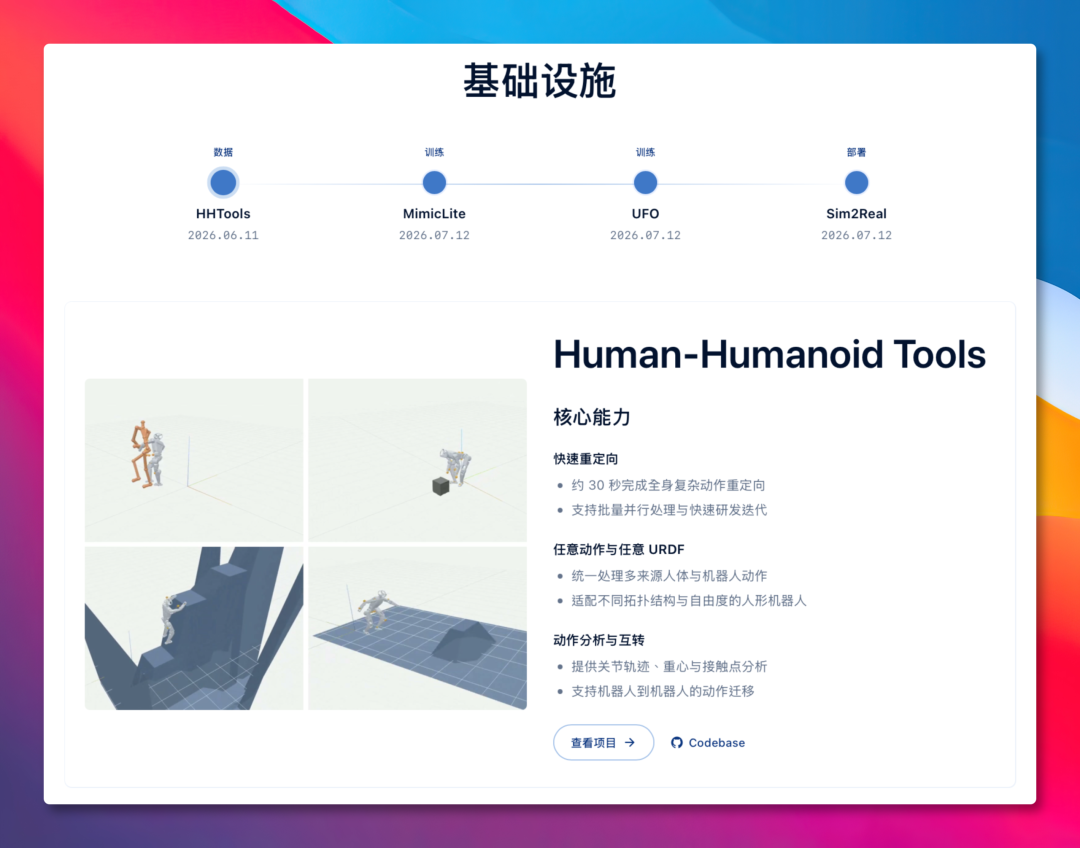
The lab also released Human-to-Humanoid Tools (hhtools), a core infrastructure tool for humanoid robots. Aimed at developers and researchers, it remaps human motion clips — parkour, dance, interaction — onto different humanoid structures, helping developers efficiently convert and validate trajectories from human motion and motion datasets to robot actions.
From MimicLite and UFO to hhtools, RoboParty continues to open up the humanoid-robot R&D infrastructure spanning training, control, deployment, and data tooling.
From ROBOTO Origin to Party OS: Making Robotics R&D Reusable
Since its founding, RoboParty has upheld a fully open-source geek philosophy, building a pure, free, and non-mediocre technical space for idealistic engineers, forward-leaning researchers, and young talent worldwide. As humanoid robotics evolves rapidly and the industry enters a critical deployment window, the field is shifting from “single-point demos” to “systemic capability competition.”
What truly determines whether humanoid robots can iterate continuously is not just one demo’s motion performance, but whether the underlying body, control algorithms, simulation training, action data, developer tools, and engineering deployment can form a reproducible, collaborative, and extensible R&D loop.
Previously, RoboParty opened the complete engineering path — from hardware structure and control systems to foundational motion capabilities — to external developers through its full-stack open-source humanoid project ROBOTO Origin. As community, developer, and user feedback poured in, RoboParty realized that open source should not stop at a one-time project release.
Instead, it should become a sustained ecosystem: gradually distilling the toolchains, methodologies, and technical modules repeatedly used and validated inside its R&D process into open infrastructure that external developers can use, understand, modify, and contribute to. That is the context in which RoboParty Lab was born.
Party OS: An Open R&D Base for Humanoid Robot Developers Worldwide
Party OS represents RoboParty’s answer to the question of how to share robotics R&D capability with more developers — a base built to be reused, extended, and contributed to by the global humanoid-robot community.